
Ask a room of college students whether they want to know the truth and hands go up. Ask whether they'd like to watch footage of animals being slaughtered and philosopher John Sanbonmatsu says the room goes still. "No one raises their hand, sensibly, because we don't want to see suffering."
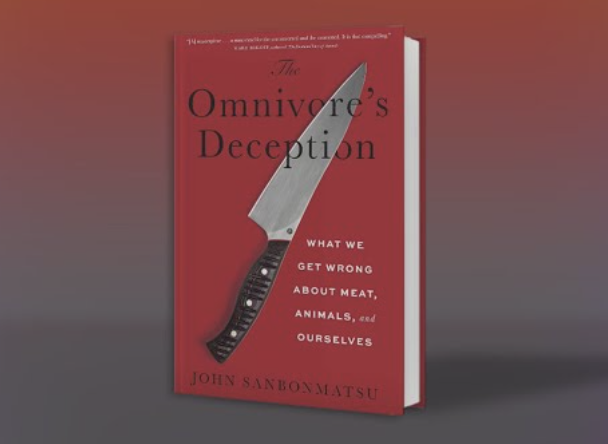
That instinct to look away is at the heart of "The Omnivore's Deception: What We Get Wrong about Meat, Animals, and Ourselves" (NYU Press, 2025). Sanbonmatsu is a professor of philosophy at Worcester Polytechnic Institute in Massachusetts and his book asks a question most people would rather not: Why do people who profess to love animals keep eating them? "We basically hide the truth from ourselves," he told Current Affairs magazine.
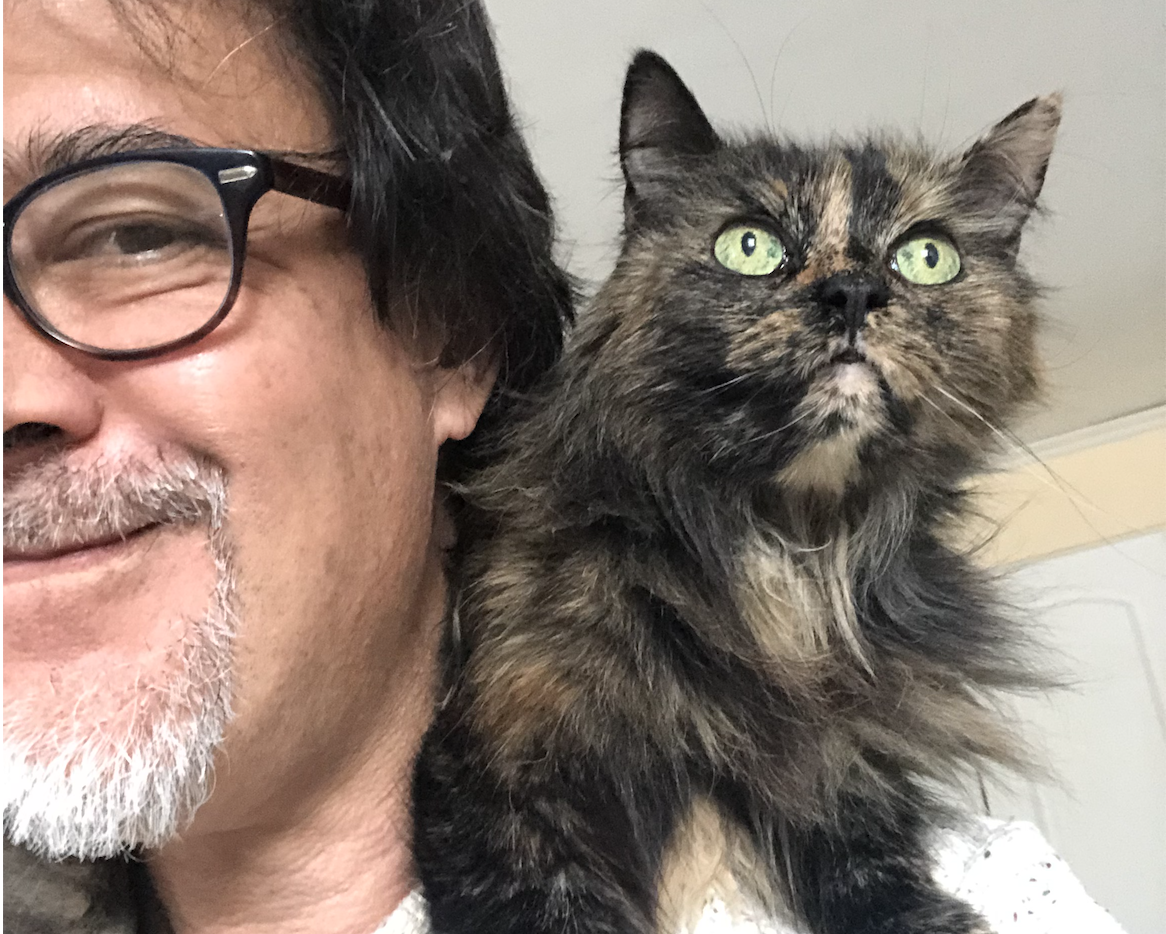
John with Fuzzy
Sanbonmatsu is one of 14 speakers coming to San Francisco VegFest on Saturday, Nov. 14, hosted by the San Francisco Vegan Society (SFVS). Now in its 27th year, the festival also features five chef demos and 90+ exhibitors at the SMC Event Center in the city's Cathedral Hill neighborhood (at Geary and Gough). His talk, "The Omnivore's Deception: 10 Myths about Meat, Animals, and Ourselves," is at 4 p.m. in Hall A. He'll sign copies of his book at his table in the Patrons Hall between 2:30 and 3.30 p.m., and at 4.45 p.m. after his session. Please note the festival ends at 5 p.m. shortly after his session wraps up.
An answer to the "omnivore's dilemma"
For two decades, the most popular story about ethical eating has gone like this: Factory farms are the problem, with meat from small, humane farms the solution. Its best-known teller is Michael Pollan, whose bestseller, "The Omnivore's Dilemma," is now, as Sanbonmatsu points out, "part of the state-mandated curriculum in middle schools and high schools across the U.S."
Sanbonmatsu's book is a direct reply. He describes a group of writers who romanticize animal farming and "tell us that we can, in fact, continue these practices but do it in a kinder, gentler, more compassionate way." His answer is blunt: "That's a lie, because other animals do suffer, even on smaller farms."
“This whole discourse of humane meat is enabling people to go through their lives with essentially a bad conscience.”
The bigger harm, he argues, is what the humane-meat story does to the rest of us. On the Our Hen House podcast, he called it "an inoculation against animal ethics, animal rights." Hence the title he chose, explaining, "That's why I call my book 'The Omnivore's Deception,' because there's a lot of deception involved."
Written for the "conflicted omnivore"
The book isn't written for philosophers. It speaks to the many Americans who think of themselves as "conflicted omnivores." This is defined as people who care about animals and worry about how they're raised … yet eat them anyway. Sanbonmatsu asks them to notice the line most of us draw without thinking. "There's no difference, ethically speaking, between a cow, chicken or pig and a cat or dog or a horse," he says.
"I wrote this book to say to the general public … this matters," Sanbonmatsu explains.
Sanbonmatsu has written about these questions for more than 20 years. He earned his Ph.D. in the History of Consciousness program at the University of California, Santa Cruz, and edited the essay collection "Critical Theory and Animal Liberation." He has also stopped softening his message. "I'm tired of apologizing for being an animal advocate," he claims.
The question The New York Times didn't ask
The book also engages one of the most influential voices in the national food conversation. Chapter 2 opens in March 2012, when the New York Times Magazine announced a contest called "Defending Your Dinner: An Open Contest for Hungry Ethicists." Readers were invited to send essays explaining why we are justified in eating animals. Pollan was one of the five judges.
Sanbonmatsu points out what that framing gave away. "The editors hadn't asked readers whether it was ethical to eat meat, but why it was," he writes. "Far from seeking to 'stigmatize' meat-eaters, then, the paper had set out to reassure them."
Still, he argues, simply holding the contest conceded something that ethical vegetarians had argued since the time of Pythagoras: “That our killing and eating of animals was neither an immutable fact of nature nor necessary for our survival, but a choice fraught with moral and even existential significance." As Sanbonmatsu puts it, "For the first time, meat had come into doubt."
A book that deserves a much bigger audience
The book won a Gold Medal in the Ecology/Environment category of the 2026 Independent Publisher Book Awards. Writing in Forbes, reviewer GrrlScientist called it "the best book I've ever read about the morality of ethical veganism and of animal rights," adding, "It is so compelling, so coherent and so crammed full of relevant information." Yet The New York Times, whose own contest anchors one of its chapters, has yet to review it.
"Michael Pollan's message, that eating animals is ethical if the farm is small enough, resonates with people who can afford to pay top dollar for the comforting thought that their dinner had a good life, paired with the ability to virtue signal their support for small farms. It also kept alive the idea that animal products are as essential to the good life as fresh air," says Rachel Bordoli, president of SFVS. "John's book offers a devastating critique of that narrative and all the other specious arguments for why there’s nothing wrong with eating animal products. 'The Omnivore's Deception' deserves to be on every bookshelf in the Bay Area, and hearing John at San Francisco VegFest is a rare chance to engage with one of the most important books our movement has produced."
For all the hard truths in his work, Sanbonmatsu doesn't leave readers without hope. He sees animal advocates as "part of this very small community of people who are trying to hold onto a kernel of hope." And he is confident about where the argument leads: "There are no good arguments for what we do to other animals. There just aren't."
